Unit Converter: Your Complete Guide to Metric and Imperial Measurements
We live in a deeply connected yet culturally standardized world. A recipe from the United States calls for cups and Fahrenheit; a road sign in Canada reads in kilometers; your new external hard drive is advertised in Terabytes, but your computer shows it as TiB. Navigating modern life, online shopping, and digital workflows requires constant translation between different systems of measurement.
A reliable unit converter is an indispensable tool, saving time and preventing costly errors in cooking, construction, travel, and computing. This guide covers the most common conversion needs and explains the systems behind the numbers.
The Global Divide: Metric vs. Imperial
The world is largely divided between two main systems of measurement: the Metric System (International System of Units, or SI) and the US Customary System (derived from the British Imperial System).
The Metric System (SI)
Used by roughly 95% of the global population, the metric system is beautifully logical. It is based on powers of 10. Once you know the base units (meter for length, gram for mass, liter for volume), everything else is simply moving the decimal point:
- Milli-: 1/1,000th (1,000 millimeters = 1 meter)
- Centi-: 1/100th (100 centimeters = 1 meter)
- Kilo-: 1,000x (1,000 meters = 1 kilometer)
The US Customary (Imperial) System
Used primarily in the United States, Liberia, and Myanmar, this system evolved from historical English measurements. Its conversions are notoriously irregular:
- Length: 12 inches to a foot, 3 feet to a yard, 5,280 feet to a mile.
- Volume: 3 teaspoons to a tablespoon, 16 tablespoons to a cup, 2 cups to a pint, 2 pints to a quart, 4 quarts to a gallon.
- Weight: 16 ounces to a pound, 2,000 pounds to a ton.
Common Real-World Conversions
Distance and Length
Whether planning a road trip abroad or buying furniture online, length conversion is the most frequent need.
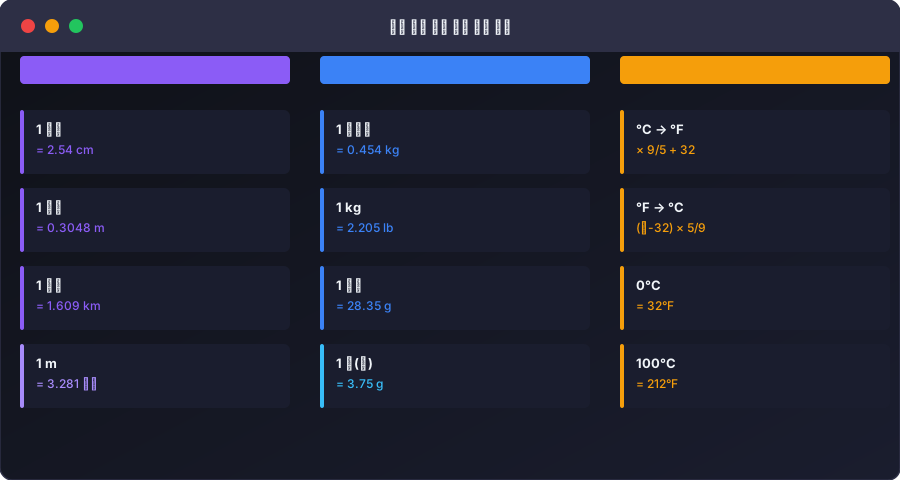
- 1 Mile = 1.609 Kilometers (To roughly convert miles to km in your head, multiply by 1.6, or use the Fibonacci sequence trick: 5 miles ≈ 8 km, 8 miles ≈ 13 km).
- 1 Inch = 2.54 Centimeters (Exactly. This is the official definition of an inch today).
- 1 Foot = 30.48 Centimeters.
Weight and Mass
Body weight, gym equipment, and baking ingredients frequently require conversion.
- 1 Kilogram = 2.204 Pounds (lbs).
- 1 Ounce (oz) = 28.35 Grams.
Temperature: Fahrenheit vs. Celsius
Temperature scales are unique because they do not share a zero point (0°C is 32°F).
- Celsius to Fahrenheit: Multiply by 1.8 (or 9/5) and add 32.
- Fahrenheit to Celsius: Subtract 32, then divide by 1.8.
Quick reference points:
- Freezing: 0°C = 32°F
- Room Temperature: 20°C = 68°F
- Human Body: 37°C ≈ 98.6°F
- Boiling Point: 100°C = 212°F
Digital Storage Units: Why Your Hard Drive Looks "Smaller"
Beyond physical measurements, the digital age has introduced a new realm of units: data storage. Let's decode bytes, megabytes, gigabytes, and terabytes.
The foundation of computing is binary (Base-2), meaning everything scales by factors of 2.
- 1 Byte = 8 bits.
- 1 Kilobyte (KB) = Traditionally 1,024 Bytes ($2^{10}$).
However, in 1998, the IEC established standard names for Base-10 (decimal) prefixes to match the metric system:
- 1 Kilobyte (KB) = 1,000 Bytes (Decimal / Base-10)
- 1 Kibibyte (KiB) = 1,024 Bytes (Binary / Base-2)
The Hard Drive Mystery: If you buy a "1 Terabyte (TB)" hard drive, the manufacturer is selling you 1,000,000,000,000 bytes (Base-10). But Windows reads storage in Base-2 (Tebibytes, TiB).
When Windows sees 1,000,000,000,000 bytes, it divides by 1,024 three times. The result is approximately 931 GB (actually GiB). Your missing 69 GB wasn't stolen; it's just a unit conversion discrepancy between the hardware manufacturer and your operating system!
Calculate Instantly with UtiliZest
UtiliZest's Unit Converter eliminates the need for mental math and complex formulas. Whether you are scaling an American recipe to metric measurements, checking the true capacity of your new solid-state drive, or converting weather temperatures for your vacation, our tool provides instant, hyper-accurate conversions.
Featuring an intuitive interface that covers Length, Weight, Temperature, and Digital Data, the converter works entirely in your browser. It instantly updates as you type, supporting dynamic swapping between hundreds of unit combinations with zero lag or page reloads.
Unit Conversion Formula Reference
Essential conversion formulas all in one place — no more searching.
Length
| Conversion | Formula |
|---|---|
| Inches → cm | × 2.54 |
| cm → Inches | × 0.3937 |
| Feet → meters | × 0.3048 |
| Miles → km | × 1.60934 |
| Nautical miles → km | × 1.852 |
Weight
| Conversion | Formula |
|---|---|
| Pounds → kg | × 0.453592 |
| kg → Pounds | × 2.20462 |
| Ounces → grams | × 28.3495 |
| Stone → kg | × 6.35029 |
Temperature
| Conversion | Formula |
|---|---|
| Celsius → Fahrenheit | × 9/5 + 32 |
| Fahrenheit → Celsius | (value - 32) × 5/9 |
| Celsius → Kelvin | + 273.15 |
Area (Real Estate / Interior Design)
| Conversion | Formula |
|---|---|
| sq ft → m² | × 0.0929 |
| m² → sq ft | × 10.7639 |
| Acres → m² | × 4046.86 |
Everyday Conversion Quick Reference
Cooking:
- 1 cup = ~240 ml
- 1 tablespoon = 15 ml = 3 teaspoons
- 1 lb of meat ≈ 450g (single steak serving = 225g = 0.5 lb)
Travel:
- Shoe size: US men's 10 ≈ UK 9.5 ≈ EU 44
- Clothing: US M ≈ EU 48
- Weight: 60 kg = 132 lbs / 70 kg = 154 lbs
- Height: 5'7" = 170 cm / 5'11" = 180 cm